
The Experience Alpha: Why 20+ years of Modular Mastery Outperforms General Contracting
Why experience matters in modular construction. Learn why a management team with 20+ years of industrial experience is essential for navigating logistics, factory-design, and 2026 project scaling.
Modular construction is a logistics and manufacturing discipline, not just a building method. This article explores why an experienced management team—one with two decades of factory-specific tenure—is the single most important factor in securing project ROI and avoiding the “newcomer” pitfalls of 2026.
The Modular “Learning Curve” Penalty
In 2026, the market is flooded with traditional general contractors (GCs) trying to pivot to modular to capture federal Build Canada Homes Act incentives. However, treating a modular project like a “site-build that happens to be in a box” is a recipe for disaster.
An experienced management team—one that has lived through the evolution of the industry since the early 2000s—understands that modularity is a Front-Loaded Discipline. While a regular contractor focuses on managing sub-trades on-site, a 20-year modular veteran focuses on Design-for-Manufacturing-and-Assembly (DfMA). If the design is only 95% complete when production begins, that remaining 5% will cost ten times more to fix once the modules are stacked.
Navigating the “Three-Body” Problem
Experienced modular managers are masters of the “Three-Body Problem”: the simultaneous coordination of The Site, The Factory, and The Transit.
- The Factory Liaison: A team with 20+ years of experience knows how to “speak factory.” They understand production line constraints, material lead times, and how to negotiate “slot and sequence” agreements that protect the developer from being bumped by larger players.
- Logistics Strategy: Moving 15-foot wide, 60-foot long volumetric modules across provincial lines involves a labyrinth of permits, pilot cars, and weather-window management. A veteran team has a “Rolodex” of specialized haulers and knows the “bridge heights and turn-radii” that an inexperienced GC would overlook until the module is stuck in traffic.
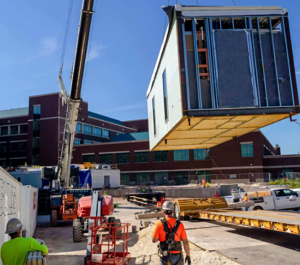
- The “Set-Day” Choreography: The moment a crane lifts a multi-million dollar module is the highest-risk minute of the project. A team that has overseen 500+ “sets” knows the subtle cues—wind speed thresholds, rigging tension, and the exact sequence of “stitching” the modules together to ensure a water-tight seal by nightfall.
Institutional Knowledge & Risk Mitigation
The “20-Year Alpha” is most visible when things go wrong. An experienced team has seen every iteration of the “modular mistake”:
- The Foundation Gap: They know to insist on “as-built” LIDAR scans of the foundation before the modules leave the factory.
- The Interface Detail: They focus on the “invisible” connections—the MEP (Mechanical, Electrical, Plumbing) crossovers—where most modular projects fail during the commissioning phase.
- Regulatory Fluency: Veterans are fluent in the CSA A277 and Part 10 building codes. They don’t just follow the rules; they know how to work with inspectors who may be seeing modular for the first time, ensuring the project doesn’t stall at the “occupancy permit” finish line.
Protecting the Developer’s Capital
For a developer, an experienced management team is an insurance policy. In 2026, lenders and institutional investors (like those funded through the Sovereignty Finance Models we discussed) look specifically at the “Resumé of the Operator.”
A team with two decades of success provides the Financial Credibility needed to unlock lower interest rates. Lenders know that a 20-year veteran won’t let a project “fail at the finish line” because of a poorly managed stitch-up or a logistics bottleneck.
Conclusion: Investing in the “Brain” of the Project In the industrialized construction economy, the “Brain” (the management team) is more important than the “Hammer” (the labor). While it may be tempting to hire a local GC with a lower fee, the “Experience Premium” paid to a 20-year modular specialist is recovered ten-fold in the form of compressed timelines, eliminated change-orders, and guaranteed quality. In 2026, the most expensive mistake a developer can make is hiring a team that is “learning on your dime.”