Risk Mitigation in Industrialized Construction: From Digital Twins to Site-Prep Precision
Precision is the ultimate hedge against project failure. This deep dive explores how 2026 developers are utilizing Digital Twin technology and advanced site-prep protocols to eliminate “foundation mismatch” and reduce onsite insurance premiums by up to 15%.
The Precision Gap: In traditional construction, a “close enough” mentality often prevails on-site. If a foundation is off by half an inch, a carpenter simply shims a wall or trims a board. In Industrialized Construction (IC), that half-inch error can halt a multi-million-dollar project. Because a steel-framed or cross-laminated timber (CLT) module is manufactured to a tolerance of less than 2mm, the site must be prepared with the same level of surgical precision.
For the 2026 developer, risk mitigation has moved from the job site to the cloud. The “Precision Gap” is being closed by the implementation of Digital Twins—virtual replicas of the physical building that exist long before the first module is cast.
The Power of the Digital Twin
A Digital Twin is not just a 3D model; it is a live, data-rich simulation. By 2026, the integration of BIM (Building Information Modeling) with real-time factory data allows developers to “build” the project virtually ten or twenty times before breaking ground.
- Conflict Resolution: AI-driven software scans the Digital Twin to find “clashes”—such as a plumbing line intersecting with a structural beam—resolving them in the virtual world for cents, rather than on-site for thousands of dollars.
- Virtual Commissioning: Developers can simulate the HVAC and electrical loads of the modules within the Twin, ensuring that once the modules are stacked, the building’s systems will perform exactly as predicted.
- Insurance Incentives: In 2026, major North American insurers are offering lower premiums for projects that utilize a Digital Twin, as the data provides a transparent “source of truth” that reduces the likelihood of future structural or water-damage claims.
Site-Prep Precision: The Foundation of Success
The most critical risk in modular development occurs at the “hand-off” between the ground-work team and the module set-crew. To mitigate this, developers are adopting Automated Site-Verification.
Using LIDAR-equipped drones, site supervisors now scan the finished foundations and compare the “as-built” data against the Digital Twin. If the anchor bolts are even 3mm out of alignment, the discrepancy is flagged instantly. This allows for corrections to be made while the modules are still in the factory or in transit, preventing the catastrophic “set-day” delays that once plagued the industry.
Logistics as a Risk Variable
In 2026, the “Last Mile” of modular delivery is managed by AI-logistics platforms. These systems track every module via GPS and internal sensors that monitor tilt, humidity, and vibration.
For the developer, this means:
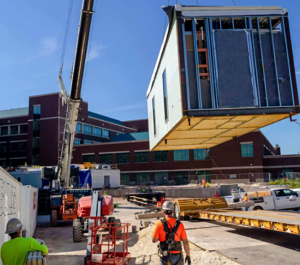
- Just-in-Time Staging: Modules arrive in the exact sequence required for the crane, eliminating the need for expensive on-site storage or double-handling.
- Transit Transparency: If a module is subjected to an extreme G-force event during transport, the sensor triggers an automatic inspection protocol before the module is lifted onto the foundation, protecting the developer from latent liability.
Conclusion: Engineering Out the Uncertainty
Risk mitigation in the modern era is no longer about having a better insurance policy; it is about having better data. By embracing Digital Twins and precision site-prep, developers are engineering the uncertainty out of the construction process. As the 2026 housing market demands faster, more reliable delivery, these technical protocols are becoming the standard for any project seeking institutional funding or federal BCH support.