Healing-Centered Design: Cultural Safety in Modern Housing
Explore healing-centered and trauma-informed design in Indigenous housing. Learn how 2026 modular homes use Two-Eyed Seeing to combine modern passive House standards with traditional cultural safety.
Housing is healthcare. In 2026, Indigenous-led design is moving beyond basic shelter to create “Healing-Centered” environments. By integrating trauma-informed layouts, Passive House air quality, and traditional spatial logic, modular homes are becoming sanctuaries for family reunification and community wellness.
For generations, government-standard housing on-reserve was designed for “compliance,” not for “connection.” These structures often featured rigid, cramped layouts that ignored the social and spiritual realities of Indigenous life. In 2026, the philosophy of Two-Eyed Seeing—balancing Indigenous ways of knowing with Western technical innovation—has redefined the architecture of the home.
Healing-Centered Design recognizes that a home can either trigger past traumas or facilitate future healing. By prioritizing cultural safety, 2026 modular designs are engineered to reduce stress, improve respiratory health, and foster a sense of belonging.
The Pillars of Trauma-Informed Layouts
Trauma-informed design (TID) focuses on creating a sense of predictability and security. In 2026, modular “kits of parts” are being customized to include:
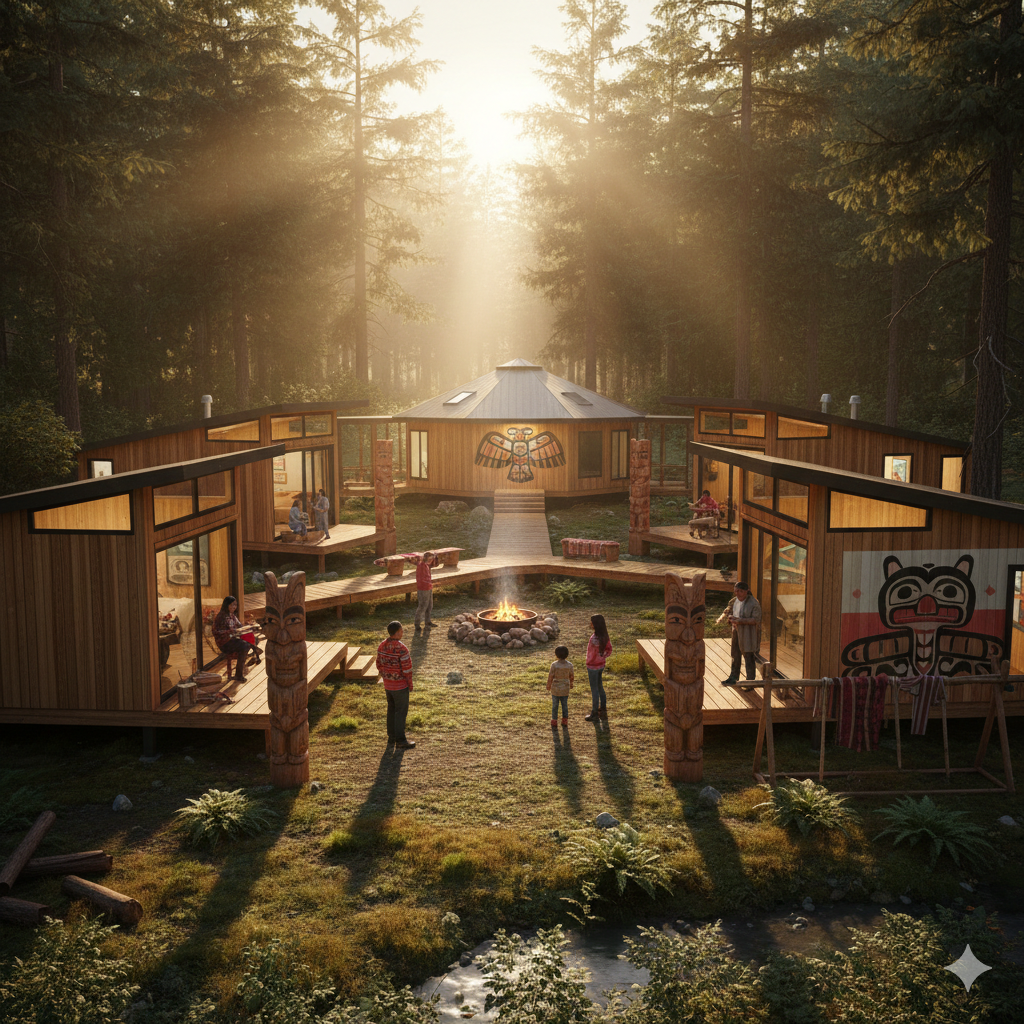
- Circular Flow & Gathering: Traditional Western homes are built around hallways (separation). Healing-centered homes are built around a central gathering space (connection), often mirroring the circular logic of a Big House or Teaching Lodge.
- Acoustic Privacy: In multi-generational homes, noise can lead to elevated cortisol levels. Modern modular units use advanced sound-dampening insulation to ensure that Elders have quiet, and youth have space, all under one roof.
- Transparent Sightlines: Clear views from the kitchen to the entryway and into the landscape provide a subconscious sense of safety and “eyes on the land,” reducing hypervigilance for residents.
“Passive House” as Preventive Medicine
In 2026, the link between substandard housing and chronic illness (such as asthma and RSV) is being addressed through Passive House standards. Because modular homes are built in a factory, they achieve an airtight seal that is nearly impossible to replicate in the field.
- Mold-Proofing: By using non-organic materials and high-performance Energy Recovery Ventilators (ERVs), these homes eliminate the moisture build-up that leads to mold—a primary “hidden” health crisis in Indigenous housing.
- Thermal Comfort: Passive House design ensures the home stays warm in a -40°C winter without relying on expensive, unreliable diesel-powered furnaces. A warm home is a stable home.
- Breathable Spaces: 2026 designs utilize “Living Walls” and materials that do not off-gas harmful chemicals (VOCs), ensuring the indoor air is as pure as the air on the land.
Designing for Seven Generations
Sustainability in 2026 is not a “green” checkbox; it is a commitment to the seven generations to come. This means choosing materials that are “of the land”—such as cross-laminated timber (CLT) or local stone—that can be maintained by local hands.
Designing with “Enough-ness” ensures that homes are rightsized. In 2026, “Expandable Modular” homes allow a small family to start with a 2-bedroom unit and “plug in” an additional module as the family grows or as an Elder moves in, preventing the overcrowding that historically led to community stress.
Conclusion: The Home as a Sanctuary
A culturally safe home is more than a building; it is a place where ceremonies can be held, traditional foods can be prepared, and sacred knowledge can be passed down without interference. By combining the precision of modular manufacturing with the wisdom of healing-centered design, Nations are building more than just houses—they are building the foundations of a healthy, sovereign future.