The Micro-Factory Blueprint: Vertical Integration for Large-Scale Land Developers
Discover the 2026 Micro-Factory blueprint for land developers. Learn how vertical integration and localized modular manufacturing are reducing costs by 20% and securing 2026 project pipelines.
As the 2026 housing crisis intensifies, top-tier developers are moving beyond sub-contracting. This article outlines the “Micro-Factory” model—a vertically integrated strategy that combines in-house design, localized manufacturing, and Indigenous-led partnerships to secure a resilient, high-margin supply chain.
For decades, developers operated as “orchestrators,” hiring architects, engineers, general contractors, and sub-trades for every new project. In 2026, this fragmented model is being replaced by Vertical Integration. By bringing the manufacturing process in-house—or forming deep “equity-level” partnerships with regional factories—developers are reclaiming the margins traditionally lost to third-party markups and logistical inefficiencies.
The 2026 standard for this movement is the Shippable Micro-Factory. Unlike the massive, $100-million modular plants of the early 2020s, these agile, 25,000-square-foot facilities are designed to service a specific region or a single large-scale land assembly.
The Blueprint: 5 Pillars of Vertical Integration
A truly integrated modular developer in 2026 controls the five key stages of the value chain. According to recent McKinsey industrial reports, companies that master this “Full-Stack” approach see EBITDA margins of 15-20%, compared to the 5% margins of non-integrated manufacturers.
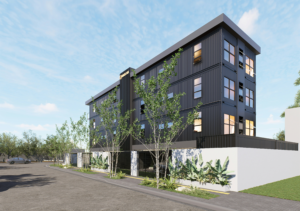
- In-House Design-for-Manufacturing (DfMA): The design team doesn’t just draw buildings; they design “kits of parts.” By using a repeatable “Platform” (as seen in the 2026 World of Modular trends), a developer can scale from a single ADU to a multi-family complex using the same structural chassis.
- Localized Manufacturing (The Micro-Factory): By placing factories closer to the land assets, developers eliminate the “Transportation Penalty.” In 2026, shipping a volumetric module more than 300km often negates the cost savings of factory labor. Micro-factories solve this.
- Direct Labor Control: In an era of severe labor shortages, a factory setting offers a “Quality of Life” advantage. Developers can offer year-round, climate-controlled employment, attracting a more diverse workforce—including the rising surge of Indigenous-led trade programs that are redefining Northern Ontario and BC construction hubs.
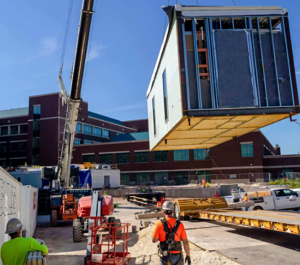
- Proprietary Logistics: Owning the crane and the transport trailers allows the developer to treat “Set-Day” as a precision event, rather than a scheduling nightmare dependent on third-party availability.
- Lifecycle Management: Because the developer owns the Digital Twin and the manufacturing data, they are better positioned to manage the long-term maintenance and “circularity” of the building, potentially repurposing modules 30 years down the line.
The Indigenous-Developer Partnership Model
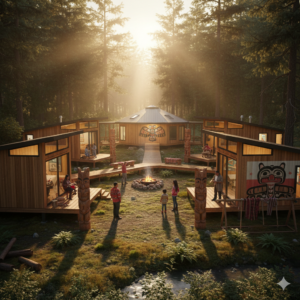
One of the most powerful trends of 2026 is the emergence of Indigenous-led Micro-Factories (such as the Anishnawbe G’Zhiitoonegamic facility in Kirkland Lake). These facilities aren’t just factories; they are training hubs and social enterprises.
For private developers, partnering with an Indigenous-led factory provides a path to Housing Sovereignty and social ROI that traditional models cannot match. These partnerships often unlock specific federal funding through the Build Canada Homes Act and CMHC’s Rapid Housing Initiative, which prioritize “Made-in-Canada” industrial solutions that empower local communities.
The Math: Why the Investment Makes Sense
While the upfront cost of a Micro-Factory (averaging $15M to $25M in 2026) is significant, the long-term math is undeniable:
- Cost Reduction: Removing the manufacturer’s profit margin (typically 15-20%) directly pads the developer’s proforma.
- Waste Elimination: Standardized “kits of parts” reduce material waste to less than 2%, compared to 15% on a stick-built site.
- Volume Certainty: A developer with their own factory is never “bumped” from the production schedule by a larger client.
Conclusion: Becoming the Manufacturer
The 2026 developer is no longer just a “builder”; they are a technology and logistics company. By adopting the Micro-Factory blueprint, large-scale landowners are insulating themselves from the volatility of the global supply chain and the unpredictability of the site-build labor market. Vertical integration is the final step in the transition from one-off projects to a high-velocity housing production engine.